

Metal Parts Warranty: What to Ask Before You Order
Metal parts warranty is a contract clause, not a kindness. It decides who fixes the problem, who pays for the fix, and how fast the line gets its parts back. Most buyers never read the clause until the month they need it. Our export company registered in December 2022. It has carried the Nanpi factory, producing since 1999, on both sides of that clause. This guide lists the four clauses that matter. It shows the evidence that wins a claim. It draws the line between a factory defect and a transit one. Read it before the first order, not after the first problem.
What a Parts Warranty Actually Covers
- Dimensional defects: the part leaves the tolerance class on the drawing.
- Material defects: the steel or alloy is not the grade on the certificate.
- Finish defects: the surface is not the finish on the sample.
- Function defects: the part fails the fit it was designed for.
Four lines, and every real claim fits one of them. What the warranty does not cover is the design itself. If the drawing is wrong, the part was made correctly. That separation, defect versus design, is the first question any honest answer starts with. It is also the first sentence a good contract should contain.
The Four Clauses to Read
| Clause | What it decides | The weak version |
|---|---|---|
| Coverage | Which defects count | “Defective parts”, undefined |
| Time limit | How long a claim can be raised | No window, or a verbal one |
| Proof | What evidence settles it | “Supplier’s inspection” |
| Remedy | What happens after a claim | Apology, no action |
Read all four before the signature, not after the first batch. The weak column is not hypothetical. It is the clause most often met in the trade. Each strong version has one property: it names a thing, a number or an action. “Defective parts” names nothing. “Measured against the drawing, reported within the stated window, replaced or credited” names everything.
Proof: Why Records Settle Claims
The claim is won with the file, not the argument. The first article report shows the baseline. The in-process records show the run stayed on it. The final QC report and the loading photos show the batch that left. When a problem appears at your dock, the file answers three questions in order. Was it out of tolerance? When did it leave tolerance? Did the pack protect it? The full inspection chain, from first article to final check, is in our post on metal parts inspection. A supplier that keeps the file answers in days. A supplier that does not answers in excuses.
Transit Damage Is Not a Factory Defect
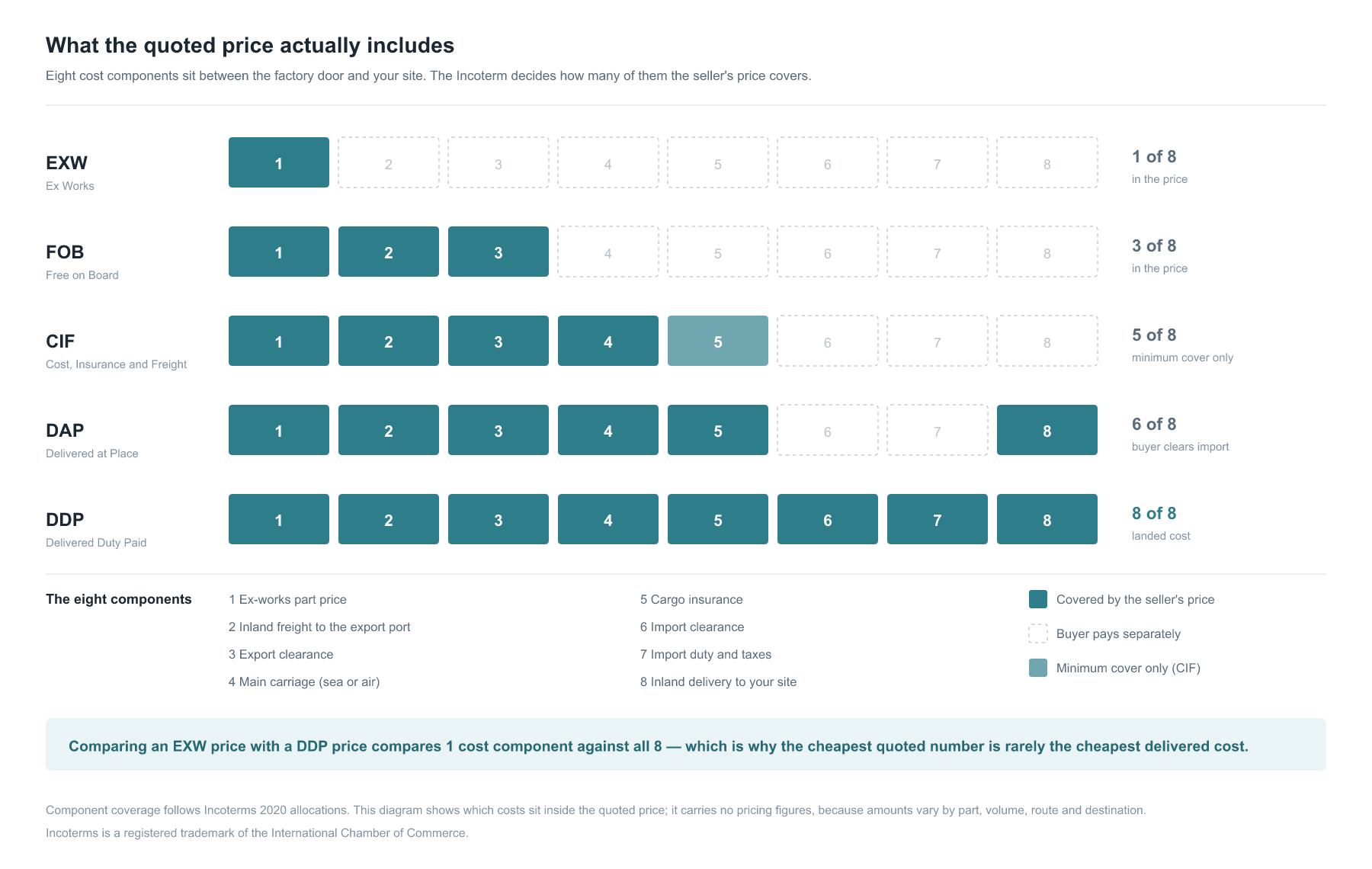
Some damage is real and is not the factory’s making. The container shifted. The corner hit the wall. The finish marked on the road, not on the floor. The line between the two is drawn by the term and the pack, together. Under the term you chose, the risk moves at a named point. The loading photos mark the state of the goods at that point. The term differences are in our post on FOB vs DDP. The pack that protects the goods on the road is in metal parts packaging. Photograph your dock before you open everything. The comparison, your photos against our loading set, is the fastest way to the right answer.
What We Cover, in Writing
- The warranty sits in the contract, not in the chat, per order.
- Coverage names the four defect lines, against the frozen drawing.
- The claim window is stated, with the proof set that settles it.
- The remedy is an action: replacement, repair or credit, named per case.
- Our process runs on the same ISO 9001:2015 system, certificate ZTZL28025Q1049R0S, that writes your quality plan. TüV Rheinland has verified the factory onsite.
One system writes the quality plan and the warranty. That is the point of the certificate. The clause and the check come from the same manual, so they cannot disagree. When a claim arrives, it runs the documented route. It has a date and an owner, like every other stage of the order. That is how a metal parts warranty should run.
Red Flags in a Warranty Conversation
- “We stand behind our parts” with no clause to point at.
- A time limit that exists only when you ask for it a second time.
- Proof defined as the supplier’s own inspection, alone.
- A remedy that is always “we will look into it”.
- Warranty questions answered by sales, with no contract owner named.
One flag is a question. Three flags are a pattern. The clause you cannot get in writing is the clause you will not get in practice. Our answer on metal parts payment terms covers the money side of the same contract. The warranty belongs in that same document, so the two never drift apart.
How a Claim Runs Here
- You report the defect, with photos, against the drawing reference.
- We compare against the FAI and the in-process records of that run.
- The file decides: factory, transit or design, in writing.
- The remedy follows: replacement, repair or credit, with a date.
- The cause goes into the corrective record, so it does not repeat.
Five steps, one file, one owner. The step most suppliers skip is the last, the corrective record. A warranty without that step pays the same claim twice. The route, including the claim handling, is described in our post on defective parts. Read both before the first order and the relationship starts with the rules already agreed.
Frequently Asked Questions
What does your warranty cover on metal parts?
Dimensional, material, finish and function defects, measured against the frozen drawing. The four lines sit in the contract, per order. Design issues are separated from defects, in writing.
How long can I raise a claim?
The window is stated in your contract, not in a chat message. It runs from delivery, and the proof set, the records and the photos, settles any claim inside it.
Who pays to return defective parts?
It follows the cause. A factory defect is on us, from the door to the rework. A transit one follows the term you chose. The decision comes in writing, with the file behind it.
Do tooling-wear defects count under the warranty?
Yes, while the part is within the class on the drawing. The die is maintained from your volume plan, and the FAI opens every run. Drift is caught at the check, not at your dock.
What if I find a defect after the first months?
Report it with the drawing reference and the photos. The records of that run are kept, and the claim runs the same five-step route. The window in your contract sets the limit, in writing.
Put the Clause in Before the Order
Send your drawing — a written warranty clause in the quote.
WhatsApp: +86 132 1225 5906 | Email: bob@xinjiuxinji.com
Or contact us online.
CNC Turning vs Milling: Which Process Fits Your Part
More Like This
-
-
-