

CNC Turning vs Milling: Which Process Fits Your Part
The phrase cnc turning vs milling decides how your part is cut, held and finished. It also sets the price, the tolerance and the lead time. One process spins the workpiece; the other spins the tool. Most custom metal parts suit one clearly. The rest need both, in one smart sequence.
Our export desk reads the drawing before the quote. It marks the process on the same sheet as the price. The company behind this desk registered in December 2022. The Nanpi factory that ships it has produced since 1999. The clock side of that decision is in our post on metal parts lead time.
What Is CNC Turning?
Turning cuts a part around one axis. The workpiece spins in the chuck. A fixed tool removes metal from the outside, the inside and the face. The result is round by nature. Cylinders, cones, threads and bores come off the machine clean. A shaft, a bushing, a flange or a coupling is a turning part. The family is simple: if it revolves, turning was made for it.
What Is CNC Milling?
Milling cuts a part against a spinning tool. The workpiece stays fixed on the table or in a vise. The tool moves in two or more axes and shapes the part. Flat faces, pockets, slots, holes and 3D contours are its territory. A bracket, a housing, a plate or an enclosure is a milling part. Where turning makes rounds, milling makes everything that is not round.
CNC Turning vs Milling: Key Differences
The two sit side by side on one simple contrast.
| CNC Turning | CNC Milling | |
|---|---|---|
| Motion | Workpiece spins, tool is fixed | Tool spins, workpiece is fixed |
| Part shape | Round, axisymmetric | Flat, prismatic, 3D |
| Typical parts | Shafts, bushings, flanges, couplings | Brackets, housings, plates, enclosures |
| Holding | Chuck, between centers | Vise, clamp, fixture |
| Best fit | Revolving parts, long runs | Complex faces, mixed features |
Read your part’s shape first. The cnc turning vs milling question ends at the shape, before the price.
When Turning Is the Right Call
- Round by design: shafts, spacers, bushings, caps, hubs, couplings.
- Revolving features: threads, tapers, grooves, concentric bores.
- Long and slender: where a chuck holds both ends true.
- Volume runs: the cycle is short and repeats cleanly.
If the drawing is a revolved profile, the answer is rarely close.
When Milling Is the Right Call
- Flat features: faces, webs, ribs, bosses.
- Pockets and slots: cavities, T-slots, contoured floors.
- Multi-direction holes: drilled, reamed or tapped from several faces.
- Non-round profiles: the whole part geometry, not one feature.
Milling wins wherever the part is not a solid of revolution.
Parts That Need Both
Some drawings mix the two families. A shaft with milled flats. A flange with a bored center, a bolt circle and machined face. The old route is two machines and two setups. The part travels, gets re-held, and gets checked twice.
The modern route is one machine that turns, then mills, then finishes. The part is held once, and the datums never move. One setup means one check chain, from first cut to final gate. The full check chain is in our post on metal parts inspection.
What Actually Drives the Price
The process is one input, not the whole bill. Four numbers move the quote more than the machine name.
- Material: aluminum cuts fast; stainless and alloy steel cut slow.
- Volume: setup cost divides across the parts in the run.
- Tolerance and finish: every micrometer of tighter or smoother costs more.
- Secondary work: plating, anodizing or deburring add a line, not a machine.
Unlike stamping, plain CNC carries no die. There is no tooling fee to amortize on a small run. That is why prototyping often starts on a machine, not a die. The die-side math, when a part later moves to stamping, is in our post on stamping tooling cost.
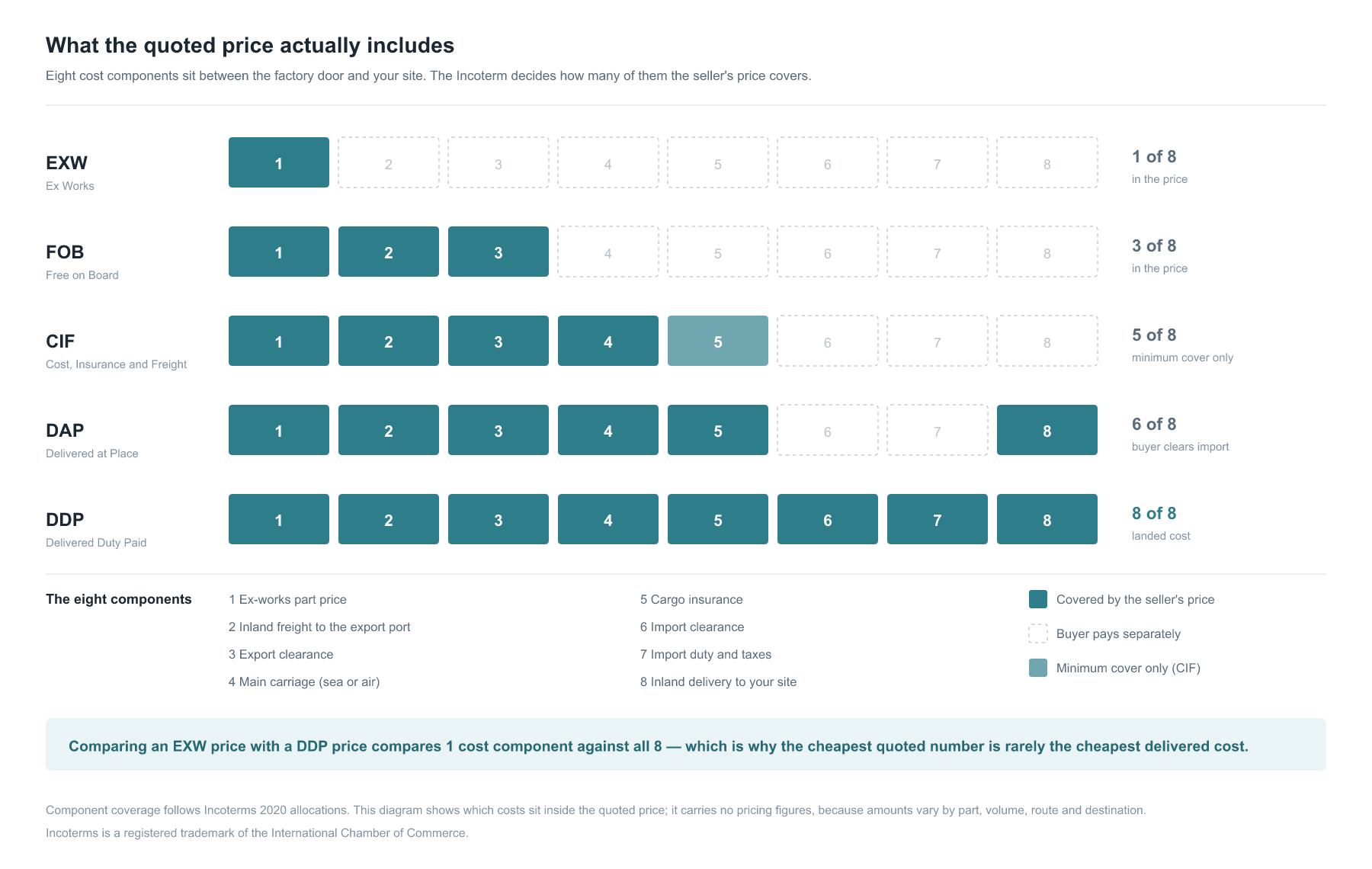
When the volume grows and the price per part falls, the terms usually move with it. Our post on payment terms covers when that shift belongs in the contract.
How to Decide for Your Part
- Draw the revolved profile. If the whole part comes from it, think turning first.
- Count the flat and pocket features. Three or more says milling.
- Check the datums. Features measured from a round center favor turning.
- Read the tolerance line. Tight concentricity favors the process that makes the axis.
- Look at the volume. Small runs start on machines; big runs earn a fixture.
When the list comes out even, send us the drawing. We read it, pick the route and mark it on the quote. The term you ship under also lands the cost; the options are in our post on FOB vs DDP.
Frequently Asked Questions
What is the main difference between CNC turning and milling?
Turning spins the workpiece against a fixed tool. Milling spins the tool against a held workpiece. The shape each one makes is the whole answer.
Which is cheaper, CNC turning or milling?
Neither, by default. The price follows the shape, the material and the volume. A simple shaft turns cheap; a complex body mills cheaper than it would turn.
Can a part be made with both turning and milling?
Yes. Many parts turn one set of features and mill the rest. A machine that does both in one holding removes the re-holding risk.
How do I know which process my part needs?
Read the shape first. Revolved features point to turning. Faces, pockets and multi-direction holes point to milling. Send the drawing and we mark the route on the quote.
Does the process choice change the lead time?
It changes the setup stage, not the clock itself. Two machines mean two setups and two checks. One combined holding means one chain, and the stage plan in our lead time post shows where it lands.
Send the Drawing, Get the Route
Send your drawing — we recommend the process with the quote.
WhatsApp: +86 132 1225 5906 | Email: bob@xinjiuxinji.com
Or contact us online.
More Like This
-

-
-