


Top 10 Sheet Metal Fabrication Companies in China: An Export Buyer’s Comparison (2026)
Disclosure: This comparison was compiled by Cangzhou Xinjiuxinji Import & Export Co., Ltd., an export supplier of custom metal parts working with a manufacturing base in Nanpi County, Hebei. Our own company appears in this list. All descriptions of other companies are based on information those companies publish publicly or that appears in publicly available industry sources; this article makes no negative claims about any company named. Each entry’s buyer note is a general sourcing consideration, not an evaluation of that company. Commercial terms change frequently — verify every figure directly with the supplier before contracting.
Why export buyers need a different comparison
Most sheet metal fabrication comparisons rank factories on shop-floor capability — what equipment they own and what tolerance they can hold. That is useful information. It is also not the information that most often decides whether a sourcing project succeeds.
An export buyer running an OEM program across borders is usually not short of capable factories. China has thousands of them, and many can hold the tolerance your drawing specifies. What separates one from another, in practice, is everything around the manufacturing: who you are actually contracting with, whether they can document what they claim, how they price and quote, how they behave when the first article fails, and whether anyone on the other side can answer a technical question in your working hours.
Those are commercial questions, not engineering ones. This comparison is organized around them.
If your selection problem is a manufacturing-capability question rather than a commercial one, those are separate evaluation criteria — and you should assess them against your own drawing rather than against a ranking.
How we compared these companies
Seven dimensions, all of them things you can ask about directly and get a documented answer to.
| # | Dimension | What to look for | Why it decides the project |
|---|---|---|---|
| 1 | Entity type and ownership | China-based factory, foreign-owned operation, foreign-headquartered with China production, or trading company | Determines who controls your production schedule, and where legal recourse sits if something goes wrong |
| 2 | Export experience in your market | Named destination countries and evidence of shipping there | Export competence is market-specific — US entry documentation and EU compliance marking are different skills |
| 3 | Order flexibility | Prototype-to-volume range, stated MOQ, whether MOQ applies per part or per material batch | A supplier that only wants 5,000-piece runs is a poor fit for a 200-piece validation build |
| 4 | Quoting and response speed | Time to first quote, DFM feedback turnaround, responsiveness to technical questions | Predicts how production issues will be handled later — this is the single most useful early signal |
| 5 | Certification and documentation practice | Certificate numbers you can verify, willingness to share inspection reports | ISO 9001 is the baseline; the differentiator is whether documentation is actually produced on request |
| 6 | Commercial terms posture | Payment structure, willingness to accept third-party audit, Incoterms flexibility | A supplier who will not discuss terms before the order rarely becomes more flexible after it |
| 7 | English-language engineering support | A named technical contact, not a generic sales inbox | Metal fabrication problems are technical. A sales-only contact adds a translation layer to every issue |
The 10 companies
Entries are listed alphabetically by company name. This is not a quality ranking — the sections below include one line on the buyer profile each company tends to suit, because fit depends on your project rather than on an overall score.
1. 3ERP
Location: Zhongshan, Guangdong, with a US office Entity type: China-based manufacturer with dual China/US presence
3ERP publicly positions itself around prototyping and low-volume production rather than volume runs, and states laser cutting accuracy within 0.1 mm, bending accuracy around 0.5°, and a working range of 0.5 mm to 20 mm material thickness. Stated prototype lead times run 5 to 10 days. The company holds ISO 9001:2015.
Buyer profile it suits: Product development teams that need 10 to 500 parts quickly for testing and validation, and who value a US-side contact for time-zone coverage.
Buyer note: For ongoing production at high monthly volumes, a company whose stated focus is prototyping and low volume is likely to be the wrong fit — ask directly what volume band they are set up for, rather than assuming capability from a product list.
2. Cangzhou Xinjiuxinji Import & Export Co., Ltd.
Location: Hebei, China, working with a manufacturing base in Nanpi County Entity type: Export entity with an associated manufacturing base
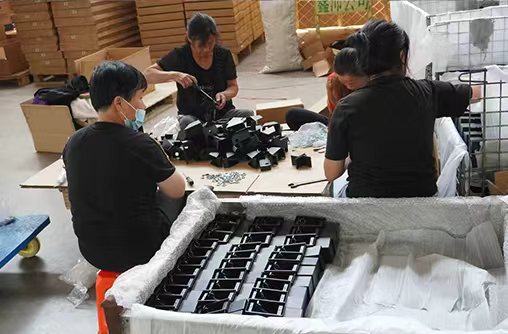
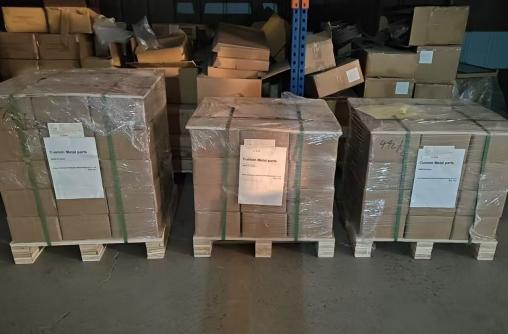
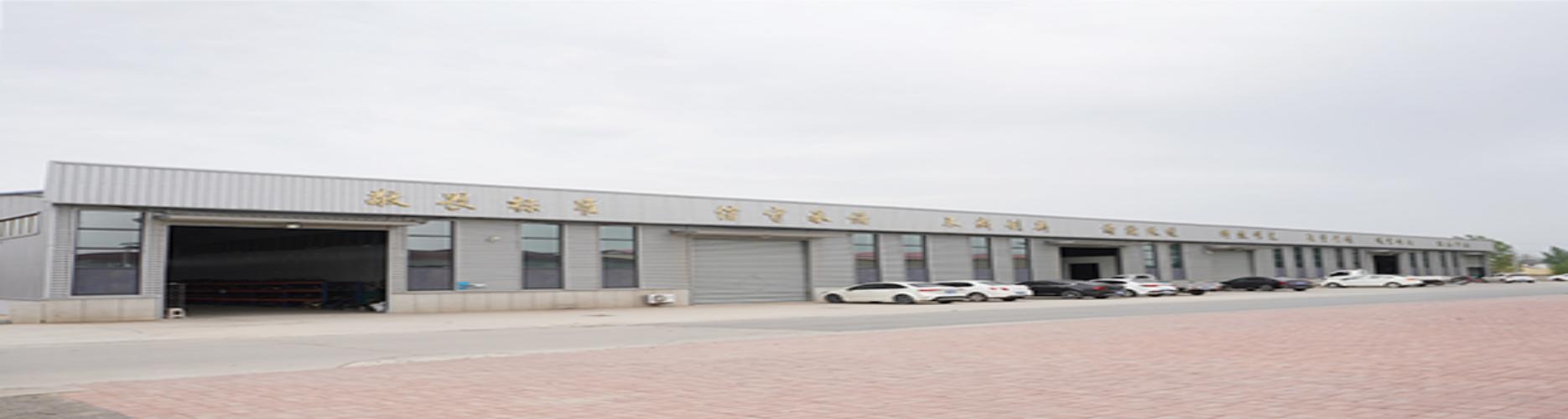
Our own company. We sit on the export side: drawings, commercial terms and documentation run through us, and manufacturing runs at the Nanpi base, which has been in operation since 1999. The base handles sheet metal fabrication, metal casting, CNC machining and surface treatment.
We hold ISO 9001:2015, and our manufacturing base has been verified on-site by TÜV Rheinland (report 485433832_P+T, valid to 31 December 2026). Customers are located in the United States, Germany, the United Kingdom, France, Ireland, Australia, New Zealand, Thailand, India, Singapore and Saudi Arabia.
Buyer profile it suits: Overseas OEMs who want a single export-facing contact for a program that spans several processes, and who need export documentation handled by the same party that discusses the part.
Where we are not the right fit: Programs that require IATF 16949 for safety-critical automotive components, or work at a scale beyond our manufacturing base’s capacity. We will say so rather than quote it.
3. KDM Fabrication
Location: Huishan District, Wuxi, Jiangsu Entity type: China-based manufacturer
KDM publicly states a founding year of 2006 and a factory of over 8,000 m², with a domain focus on metal enclosures and industrial cabinets — electrical housings, server racks and equipment cabinets. The company states it works with material from 0.5 mm to 20 mm and holds ISO 9001:2015 and AS9100D (aerospace), alongside CE, RoHS and SGS listings. Equipment listed includes robotic welding, waterjet cutting, CNC punching and press brakes.
Buyer profile it suits: Buyers sourcing enclosures, cabinets and housings, where the supplier’s domain knowledge shortens the DFM conversation. Aerospace-adjacent programs that need AS9100D on paper.
Buyer note: Ask for the certificate numbers and verify them on the issuing body’s directory. A listed standard is a claim until the number checks out.
4. Komaspec (Komacut)
Location: Guangzhou, with facilities in Vietnam and Mexico Entity type: Canadian-owned contract manufacturer
Komaspec publicly states it was founded in 2005 and operates across China, Vietnam and Mexico under one quality system, with over 6 million precision parts produced annually. Its published capability list includes LVD press brakes, 12 kW fiber laser cutters and robotic welding cells, and it holds ISO 9001:2015. The company operates Komacut, an online platform that returns instant quotes and DFM feedback.
Buyer profile it suits: Buyers who need the same part producible in more than one country — for tariff exposure, regional supply requirements, or dual-sourcing — and mid-volume, high-mix programs with many SKUs.
Buyer note: With a multi-site supplier, confirm which facility will build your part and request capability data from that specific site rather than from the group. Also clarify which party issues your quotation — platform and factory pricing are not always the same.
5. Masion
Location: Ningbo, Zhejiang Entity type: China-based vertically integrated manufacturer
Masion publicly states a founding year of 2007, a facility of 30,000 m² across six production plants, and a workforce of over 400. Its stated model is full vertical integration — laser cutting, stamping, bending, welding, injection molding, surface treatment and assembly in-house — supported by stated client relationships with Geely Auto, Lixiang Auto, CRRC, AUX and Costco. The company states ISO/TS 16949 certification.
Buyer profile it suits: Programs where a large share of the value is in in-house process consolidation, and buyers who want a single supplier through to assembled product.
Buyer note: A domestic-OEM-heavy client base is a genuine capability signal, but confirm the depth of English-language engineering support for your specification package, and allow additional clarity in written specifications.
6. Maxtech Manufacturing
Location: Jinshan Industrial Zone, Shanghai Entity type: China-based manufacturer
Maxtech publicly states a founding year of 2000 and over 25 years of export experience, positioning as a multi-process manufacturer covering sheet metal, plastic molding, metal casting and CNC machining. It states over 20,000 sheet metal products delivered globally and exports to North America and Europe.
Buyer profile it suits: Programs spanning several materials and processes where one purchase order across all of them is worth more than depth in any single one.
Buyer note: Ask which processes are genuinely in-house at the quoting site. With a broad process list, it is worth mapping where your specific part will actually be made.
7. RapidDirect
Location: Shenzhen Entity type: Digital-first manufacturer operating an in-house factory plus a partner network
RapidDirect publicly states a founding year of 2009, around 20,000 m² of in-house factory space plus 50 partner facilities, and more than 20,000 customers across 120+ countries. It states sheet metal prototype lead times from 3 days, no minimum order quantity, and four certifications: ISO 9001:2015, ISO 13485, ISO 14001 and IATF 16949. Quoting is handled through an online engine that returns pricing and DFM feedback.
Buyer profile it suits: Buyers who want a fast, structured, comparable quotation process and the flexibility of single-piece orders — useful when validating a design across several candidate suppliers before committing.
Buyer note: A hybrid model combining an owned factory with a partner network gives scale and flexibility, but introduces a variable: ask which specific facility will run your order, and whether consistency of a repeat part is guaranteed across sites.
8. Redstone Manufacturing
Location: Headquarters in Boulder, Colorado, USA, with production in China Entity type: US-headquartered company with China manufacturing
Redstone publicly describes a model that combines US-based design and account management with Asian production, serving industrial, automotive, aerospace and consumer-product markets. Stated capabilities cover laser cutting, stamping, bending, robotic welding, assembly and finishing options including powder coating, anodising and plating. The company states ISO 9001:2015 for its sheet-metal fabrication service.
Buyer profile it suits: Buyers who want a domestic counterparty and contracting entity while retaining China-based manufacturing economics — often chosen for procurement-policy reasons rather than price.
Buyer note: When the contracting entity and the manufacturing site are in different countries, be explicit about which entity bears warranty and rework obligations, and where a dispute would be resolved.
9. SUPRO MFG
Location: Shanghai Entity type: China-based manufacturer
SUPRO publicly states a factory of over 3,000 m² with three automated manufacturing bases, over 20,000 projects delivered to more than 3,500 buyers, and certifications including ISO 9001:2015. Published service terms mention weekly progress reporting during production and DFM support capable of developing a design from a concept rather than a finished drawing. Sheet metal is the core offer, with casting and CNC machining also listed.
Buyer profile it suits: Buyers of brackets, enclosures, panels and structural parts who want regular production visibility and are comfortable working with a smaller, more focused operation.
Buyer note: Weekly progress reporting is only useful if it is specific. Ask what the report contains before you rely on it as your production window.
10. TUOFA Precision
Location: Shenzhen Entity type: China-based manufacturer
TUOFA publicly states a founding year of 2006, over 50,000 sq ft of facility and more than 100 CNC machines, with capabilities covering metal stamping, CNC punching, bending and surface treatment. It holds ISO 9001:2015 and IATF 16949, and states tolerances to 0.005 mm and a self-reported on-time delivery rate of 99.88%. Stated rapid prototyping lead times run 5 to 23 days.
Buyer profile it suits: Buyers in regulated industries — automotive especially — who need documented quality systems, and programs spanning stamped and machined components.
Buyer note: Delivery-rate figures published by a supplier are self-reported. Request references from customers in your market and, on a first order, verify performance with a pre-shipment inspection.
Comparison at a glance
| Company | Location | Entity type | Export markets (publicly stated) | Stated MOQ posture | Certification (public) | Fits buyers who need |
|---|---|---|---|---|---|---|
| 3ERP | Zhongshan + US office | China-based, dual presence | Not specified | Prototype/low volume focus | ISO 9001:2015 | Fast validation builds, US-side contact |
| Cangzhou Xinjiuxinji | Hebei | Export entity + manufacturing base | US, DE, UK, FR, IE, AU, NZ, TH, IN, SG, SA | Project dependent | ISO 9001:2015; TÜV Rheinland on-site verified | Multi-process programs with export handling in one place |
| KDM Fabrication | Wuxi | China-based | Not specified | Not specified | ISO 9001:2015, AS9100D, CE, RoHS | Enclosures, cabinets, aerospace-adjacent |
| Komaspec | Guangzhou + VN + MX | Canadian-owned | Global OEM | Mid-volume, high-mix | ISO 9001:2015 | Multi-country supply, dual sourcing |
| Masion | Ningbo | China-based, integrated | Domestic-led, growing export | Not specified | ISO/TS 16949 | In-house consolidation to assembly |
| Maxtech | Shanghai | China-based | North America, Europe | Not specified | Not stated | Multi-process, single purchase order |
| RapidDirect | Shenzhen | Digital-first + partner network | 120+ countries | No MOQ stated | ISO 9001:2015, ISO 13485, ISO 14001, IATF 16949 | Fast quoting, single-piece to volume |
| Redstone | US HQ + China production | US-headquartered | Industrial, automotive, aerospace | Not specified | ISO 9001:2015 | Domestic counterparty, China economics |
| SUPRO MFG | Shanghai | China-based | 3,500+ buyers worldwide | Not specified | ISO 9001:2015 | Regular progress reporting, smaller runs |
| TUOFA Precision | Shenzhen | China-based | Not specified | Not specified | ISO 9001:2015, IATF 16949 | Regulated industries, stamped + machined |
“Not specified” means the figure was not published in the sources reviewed. All figures are as publicly stated by each company or by publicly available industry sources, and have not been independently verified by us.
Five things export buyers get wrong
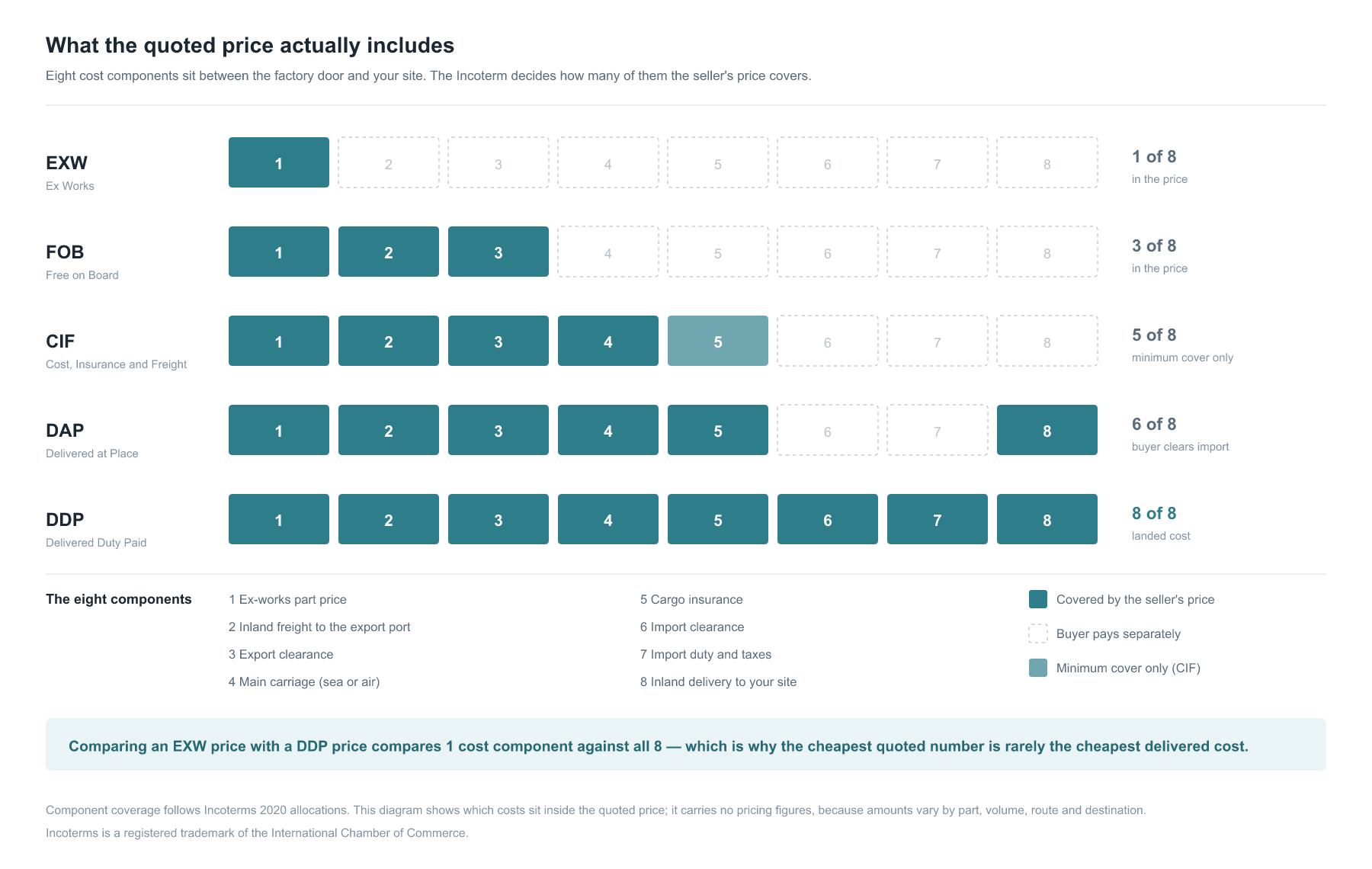
1. Comparing on unit price when the Incoterm differs. A price quoted EXW and a price quoted DDP are not the same number in any meaningful sense. Before comparing quotes, confirm the Incoterm, the named port or place, the material grade, the finishing, the packaging and the order quantity. Fix that basis first, then compare.
2. Treating ISO 9001 as a capability claim. ISO 9001:2015 says the factory has a functioning quality management system. It does not say the factory can hold your tolerance. Ask for the certificate number and verify it, then ask a separate question about process capability on your specific part.
3. Skipping the question of who you are contracting with. Ask for the business license and compare the registered name with the entity on the quotation. This is not about factory-versus-trader snobbery — both models are legitimate. It is about knowing whether your production schedule is controlled by the party you are negotiating with, and where your contractual recourse sits.
4. Testing communication only during quoting. A supplier who answers quickly while chasing your order and slowly after it is a common pattern. Send one technical question with a deliberate ambiguity early, and see whether it comes back with a clarifying question or a confident answer. The second response is the useful signal.
5. Leaving payment structure to the end. Payment terms are a risk-allocation decision, not an afterthought. Agree the deposit percentage, the balance trigger, the accepted payment method and — for larger first orders — whether a letter of credit or escrow structure is appropriate, before production starts. Treat a demand for full payment upfront on a first order as a negotiating position rather than a standard term.
Frequently asked questions
How do I choose a sheet metal fabrication company in China?
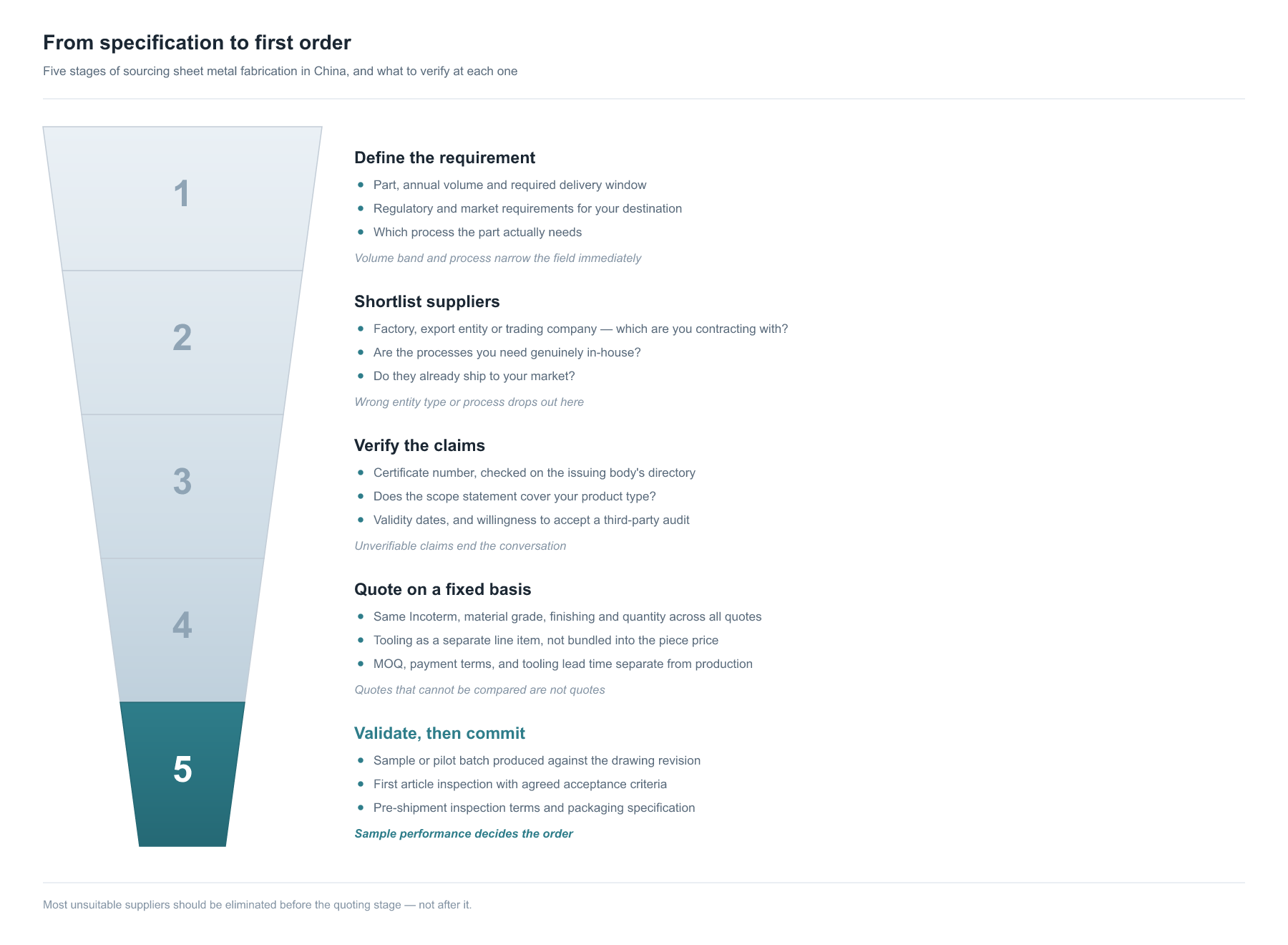
Work in this order. First, define the part, the annual volume and your required delivery window — suppliers optimize for different volume bands and about half will be the wrong fit immediately. Second, shortlist three to five companies whose stated focus matches your volume and process. Third, verify their certifications by certificate number rather than accepting a document image. Fourth, request quotes on a fixed, identical basis — same Incoterm, same material grade, same finishing, same quantity — or the numbers are not comparable. Fifth, order samples before committing to a production order. Price is a poor first filter because it is usually a scope difference rather than an efficiency difference.
What is the difference between a sheet metal fabricator and a trading company?
A fabricator owns and runs the manufacturing equipment, so it controls its own production schedule and is usually cheaper on work that fits its machines. A trading company or export entity coordinates factories — a legitimate model that often brings broader process coverage, better export documentation experience and English-language account management, at the cost of a margin and some visibility into scheduling. Neither is inherently better. The problem is not knowing which one you have: ask for the business license and compare the registered entity name with the company you are negotiating with.
Do Chinese sheet metal fabricators have a minimum order quantity?
It varies widely, and the stated MOQ often differs from the practical one. Some companies publicly state no minimum at all for prototyping and single-piece work; others are set up for production runs and will quote small quantities at a punitive piece price that effectively declines the work. For parts made on existing tooling, a few hundred pieces is common. For custom tooling, the practical minimum is driven by how many pieces you must buy for the tooling cost to be acceptable per unit — so ask for the tooling as a separate line item and do that arithmetic yourself.
How long does it take to get a quote from a sheet metal fabricator in China?
For a straightforward part with a clear drawing, an initial indicative price can come back within 24 hours. What takes longer is the DFM review — the engineering comments telling you whether the part is manufacturable as drawn. Some companies publish their response targets, which is a useful signal, but a published target is not a guarantee. Treat the DFM response rather than the price as the more informative artifact: a complex part priced in minutes with no questions asked has probably not been reviewed.
What payment terms are standard for a first order with a Chinese fabricator?
A deposit with the balance against shipping documents is the common structure for a first order — typically in the region of 30% deposit and 70% on document presentation. Tooling is usually paid separately, staged against design approval, build completion and first article approval. For larger first orders, a letter of credit adds a layer of bank protection for both sides. Treat a demand for full payment upfront on a first order as a negotiating position rather than a standard term, and expect terms to improve on repeat orders.
Should I visit a sheet metal factory in China before ordering?
For a first order above roughly USD 20,000, or for any program where you are funding tooling, a visit or a formal third-party audit is usually worth the cost. If travel is impractical, ask for a live video walkthrough showing the actual equipment and the QC area — and ask them to show a part currently in production, not a display sample. A third-party audit conducted on site is a reasonable substitute and is typically priced per inspector-day; confirm scope before booking, because a generic audit is less useful than one built around your drawing.
What documents should I receive when importing sheet metal parts from China?
Expect at minimum a commercial invoice, a packing list, and either a bill of lading for sea freight or an air waybill for air freight. Depending on your market and product you may also need a certificate of origin, material or mill certificates, an inspection certificate, test reports or safety data sheets for finishes, and confirmation that wood packaging meets ISPM 15. Your customs broker is the right party to confirm the exact list for your entry, as requirements vary by market and product.
How do I verify a Chinese supplier’s ISO 9001 certificate?
Ask for the certificate number and the issuing certification body, then look the number up on that body’s public certificate directory. Check three things: that the number exists, that the scope statement covers your product type, and that the certificate is currently valid. Certification bodies include TÜV, SGS and Bureau Veritas, all of which publish verifiable records. A certificate image with no number cannot be verified and should not be treated as evidence.
Next step
If you are evaluating sheet metal fabrication suppliers and want a quote that states its basis clearly — Incoterm, material, finishing, packaging and volume — send us the drawing. Our manufacturing base in Nanpi has been in operation since 1999 and holds ISO 9001:2015, verified on-site by TÜV Rheinland. We will tell you whether your part fits our base, and if it does not, we will say so.
Published by Cangzhou Xinjiuxinji Import & Export Co., Ltd., Hebei, China. Company descriptions are summarized from each company’s own public statements or publicly available industry sources and have not been independently verified by us. Commercial terms change frequently — confirm all figures directly with the supplier. Last updated: September 2026.
Material Standards Cross-Reference: Grade Mapping Guide
More Like This
-
-
-