

What actually sets the duty rate on imported metal parts
Buyers often ask us to quote a landed price and then ask why the landed price moved. The answer is usually that the duty rate on metal parts is not a fixture. It is the output of a legal calculation that changes when the classification changes, when the origin changes, or when a trade measure is imposed. Understanding the mechanism is what lets you budget with a straight face.
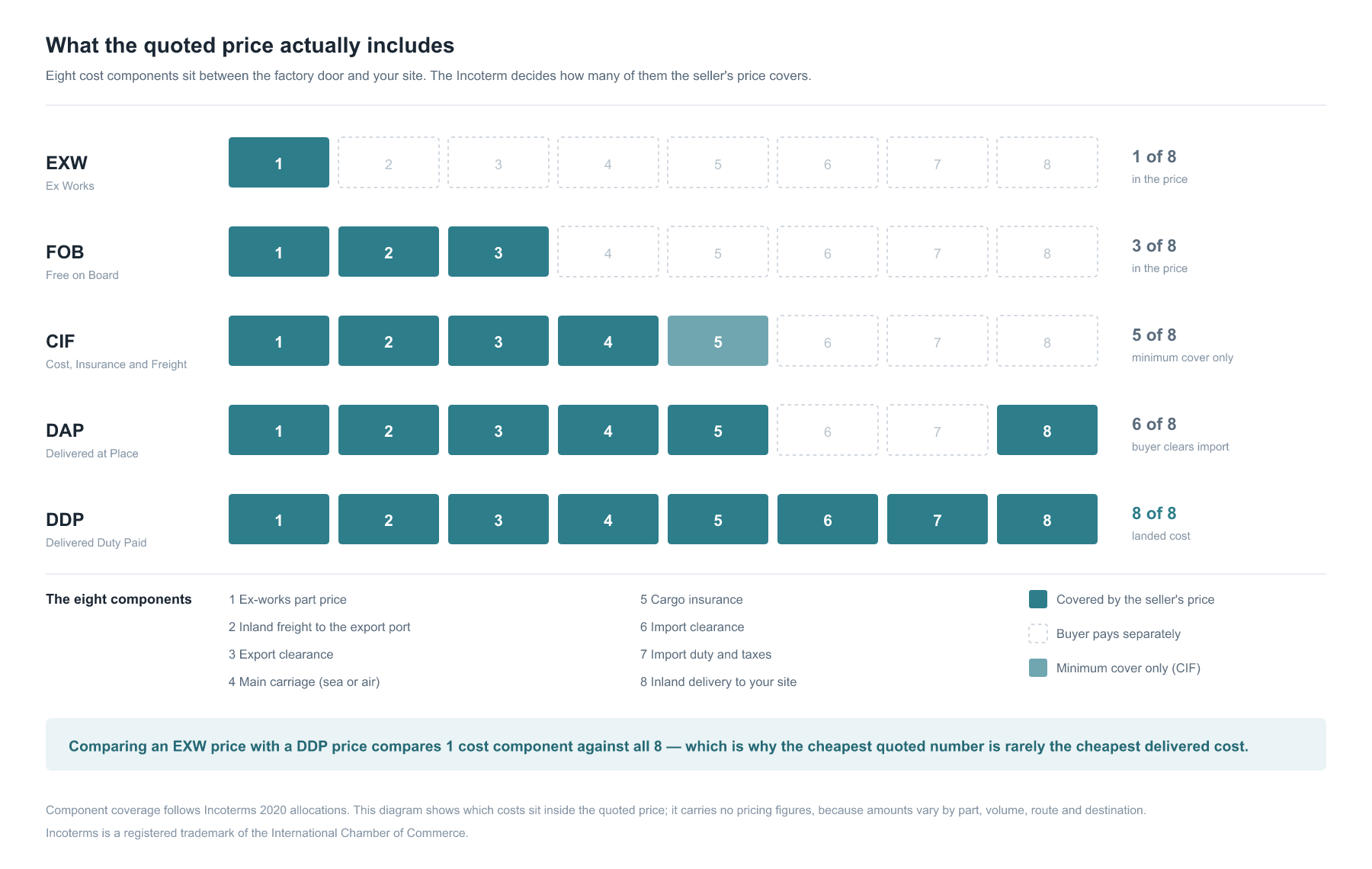
| What the quoted price covers | Components inside the price | Who carries the risk |
| Ex works, at our door. | The part price alone. | The buyer, from our loading bay onward. |
| Free on board, at the export port. | Inland freight and export clearance, added. | The buyer, once the goods are on board. |
| Delivered at place, at your site. | Main carriage and delivery, added. | The buyer clears import and pays the duty. |
| Delivered duty paid, at your site. | All eight components, added. | The seller, through to the named place. |
The rate follows the classification first
Every duty calculation begins with a code. The code identifies the goods, and the schedule attaches a rate to that line. Therefore two importers bringing in what looks like the same bracket can face different treatment, because one classified it as a steel article and the other classified it as a part of a machine.
That is the single most useful thing to understand. The rate is downstream of the analysis, not upstream of it. If you want to control the rate, start by controlling the classification, and do it before the first shipment rather than after.
Then the origin
The same goods can attract different treatment depending on where they were made. Origin is a legal concept with its own rules, and it is not the same as the place of export. Consequently a shipment can leave one country and still be of another origin for duty purposes.
This matters for metal parts because processing can be substantial without changing origin. If you are relying on a preference programme, confirm the origin rules for your specific product rather than assuming the last country of processing decides it.
Then any measure in force
On top of the schedule, additional measures can apply to specific goods from specific origins. These include trade remedies such as anti-dumping and countervailing duties, safeguard measures, and tariff actions taken under trade legislation. They are separate from the base schedule and they change on their own timetable.
This is where a hard-coded rate becomes actively misleading. A page that prints a figure cannot know which measure is in force on the day you read it. Therefore we describe the mechanism and hand you the official place to look.
If you want to see how the components behave under each delivery term, what the duty rate on metal parts is made of is set out term by term on our Incoterms page. The picture changes with the term, even when the rate does not.
Then the declared value
Customs applies duty to a value, so the valuation method matters as much as the rate. You build the customs value from the price you actually paid, plus defined additions such as certain freight and assists. It is not simply the number on the invoice.
Keep the commercial invoice, the packing list and the drawing consistent, because the value story has to hold together across all three. A cheap invoice with a detailed drawing invites a question you will not enjoy answering.
How to check the rate that applies today
Use the official tools, and use them close to the shipment date.
For the United States, the Harmonized Tariff Schedule published by the USITC carries the schedule itself and a change record. CBP’s Basic Importing and Exporting pages cover duties, taxes and fees from the collector’s side. The Office of the United States Trade Representative publishes tariff actions taken under trade legislation, and trade remedy cases run through the Department of Commerce. For a written position on your own goods, ask CBP for a binding ruling.
Do this before you finalise a landed-cost budget, not after. A rate checked at quotation time and re-checked at shipment time is a rate you can defend.
What this means for a quote from us
We quote the components we control. That means the part price, the inland freight to the export port, the export clearance and, where the term requires it, the main carriage. Duty is set by the destination authorities, so it is not ours to fix.
Therefore a delivered quote from us can include a stated duty basis without guaranteeing the duty itself. If the measure changes between quotation and entry, the change lands on the landed cost. We would rather say that plainly than print a number that expires.
Frequently asked questions
These are the questions buyers raise most often about duty on metal parts.
Why can two similar brackets attract different treatment?
Because classification and origin can differ even when the parts look alike. A bracket classified as a steel article and the same bracket classified as a machine part sit in different places in the schedule, and origin can add a further layer on top.
Can I lock in a duty rate before ordering?
Not as a fixed figure. You can obtain a binding ruling on classification, and you can confirm which measures are in force today. However, measures can be imposed or removed after your ruling, so treat the rate as information with a date on it.
Does the delivery term change the duty?
The term does not change the legal rate, because the rate attaches to the goods. It does change who pays, who files the entry, and therefore who carries the cash-flow and compliance risk. That is why the same shipment can look cheaper under one term and cost more overall.
Who is responsible if the declared rate is wrong?
The importer of record. That responsibility survives the appointment of a customs broker, because the broker files on your behalf rather than in your place. If you discover an error, correcting it voluntarily is much cheaper than being found out.
US import documents for metal parts: what to collect, and from whom
More Like This
-

-
-